Arak the Warrior
5000 BC – Europe
Arak the Warrior raised his head above the ditch and listened, but no sound came from the settlement except for the occasional bleating of one of the captive goats. He strained his eyes, yet nothing stirred in the dim light of the breaking dawn. The settlers were all asleep, oblivious to the doom about to befall them.
The wind carried ash from the village on its wings and swept on between the stumps of the felled trees surrounding the settlement. They were like ticks, these settlers. They clung to the earth and sucked its blood. They destroyed the forests, bent the plants to their will, scorched the land, and made the animals their slaves. They hid themselves away in their great houses and had forgotten the spirits of the Ancestors. Fire spread through Arak’s chest.
There were more and more of them with every passing season. They spread like a wasting sickness, raising their great houses, speaking in their strange tongues, and kneeling before their alien idols. Arak tightened his grip on the axe in his hand until his arms trembled. And wherever they could, they slaughtered the Forest People without honor.
How many summers had passed since they had betrayed his parents, stolen their lives and the furs they had gathered for trade? And his sister… He had been little more than a boy. They should burn, those inhumans.
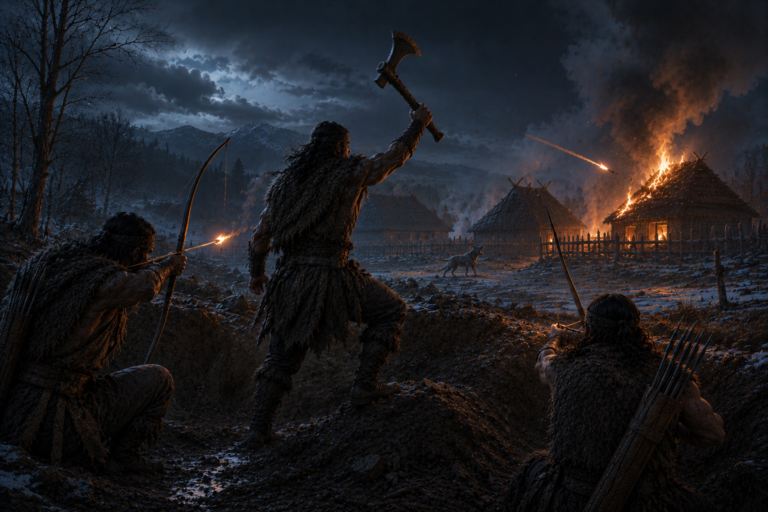
He looked over at Ketu and Oru and nodded. Using flint, they lit the resin-soaked torches planted in the ground before them. The sharp crack of stone against stone echoed through the stillness of dawn, but it would make no difference now. One of the village dogs barked, yet the torches were already ablaze. Ketu and Gira took the bows from their backs. Each held the tip of an arrow into the flames, set it to the string, and waited with drawn bows for his signal.
Arak nodded, fire burning in his eyes, and almost without a sound, like falling stars, the arrows glided through the air and buried themselves in two of the thatched roofs. For a heartbeat everything stood still, as though time itself had stopped, and the fire began to devour the dry wood, and night was no more. More arrows flew, the dogs barked in a frenzy and the first voices rang out from the houses, the first screams.
Arak raised his head and saw a great eagle soaring across the sky. A grim smile touched his lips; the Ancestors were with them. He lifted his axe high above his head, roared with all the strength in his lungs, climbed out of the ditch, and charged toward the burning village, his warriors close at his heels.
The dogs came first, not even a handful of them, barking and growling. One was pierced by a burning arrow—Ketu the Archer never missed—and the animal ran wildly about, whimpering in agony. Then the others were upon them. Arak caught a glimpse of Eru stepping into the path of one as it sank its teeth into his arm, while he himself barely avoided a great beast that hurled itself at him with claws outstretched. The dog landed, spun around in an instant, and sprang again with bared fangs. Arak swung his axe with all his strength, burying the blade deep into the animal’s shoulder. The light faded from its eyes, and it collapsed lifeless at his feet.
Wild-eyed and his heart pounding, Arak looked around. The dogs were all dead. Eru clutched his bleeding arm. A sharp whistle cut through the roar of the flames, and an arrow buried itself in Nek’s chest. Nek of the Great Water dropped to his knees and fell face-first to the ground. Arak let out a furious roar and charged the archer standing before one of the burning houses. Around him, the others roared as well and rushed toward the dark silhouettes of the settlers.
A man came at Arak with an axe raised high, but Arak slipped aside from the slow blow, stepped behind the Inhuman, and, with fire coursing through his veins, drove his own axe into the man’s back. Screams tore through the air. Let them all die. Let their souls wander forever through the Void!
He kept running until he reached the archer. With his throat torn open, the coward crumpled to the ground. Hot blood splashed into Arak’s eyes. Dully, he remembered the first time he had killed a man, a few summers ago. He burst into harsh laughter, laughing at the memory, at the nausea that had once gripped him. Blood, fire, and ash drove every thought from his mind.
In front of one of the burning houses, Eru struggled with a settler while, behind him, a woman crouched on the ground clutching a child. Hampered by his wounded arm, Eru was forced backward as the settler swung again. With a cry, Arak leapt between them and hacked the man’s hand from his arm. Foreign blood sprayed across Arak’s face as he buried his axe deep into the enemy’s chest.
Panting, he tightened his grip on the blood-slick handle and glanced around in search of more enemies. There were none left. Groans and cries of pain filled the air, mingling with the crackle of fire, the crash of collapsing beams, and the sobbing of women and children.
Arak raised his bloodstained axe high into the air and roared, and the others roared with him. “Throw the dead into the idol house!” he shouted above the chaos. Should their souls wander. They had turned their backs on the Ancestors, there was no reason to return them to the earth.
He turned toward the woman and the whimpering child on the ground. They shrank away from him. Arak knelt before her and studied her face in the flickering firelight. A shiver ran through him. Never before had he seen a woman so beautiful. Her features were flawless, framed by dark hair, and her dark eyes watched him with fear. He shook himself and rose to his feet. “Take her to the other women and the children,” he ordered Eru the Tracker. “She belongs to me.”
Arak seized the dead body of the settler whose hand he had cut off and dragged it toward the burning idol house, which, like in every other settlement he had seen, stood in the center of the village and was the largest building of them all. The heat pressed against him as he reached it, and, breathing heavily, he shoved the corpse into the flames.
He followed the frantic bleating of the goats to their pen, where Kar and Orua were already standing. “…wouldn’t it be better if we kept some ourselves? For the winter?” he heard Orua say. Arak stepped up to him and struck him hard across the face with the back of his hand. “They rob the animals of their dignity. We will not become like the enemy.” Orua wiped the blood from the corner of his mouth and glared at him resentfully. “Kill the goats. We’ll take their meat,” Arak ordered, then turned away and walked over to Nek’s body. Kneeling beside him with a heavy heart, he pulled the arrow from his chest. So few of them remained now—not even two handfuls of warriors.
As gently as he could, he lifted the body onto his shoulder and carried it to the others waiting at the edge of the settlement, where they were guarding a handful of women and children, keeping them apart. He carefully laid Nek’s body on the ground and felt Eru’s hand on his shoulder. “Warrior Arak, I… I think… look for yourself,” he said, pointing toward one of the women standing beside the dark-haired beauty. What did Eru mean?, Arak wondered, puzzled. She looked a little different from the others, but… His heart stopped. She had become a woman, and she wore the clothes of the settlers, but those eyes… Could it truly be? He staggered toward her, while she stared back at him with the same disbelief. “Rava?” he whispered. “Rava!” She threw herself into his arms, whispering his name. A goat let out one final shrill cry before it died.
Arak stepped back and stared at his sister in stunned amazement. To find her again after all this time—he had long since given up hope. With bloodstained hands, he wiped the blood from his face and looked up. The sky was turning blue; the sun would soon rise. They could not linger here much longer.
“What about the brats? Into the fire as well?” Orua asked, nodding toward the whimpering children. Rava raised her voice. “The boy over there, the one with the fair hair, is my son, Telamon. His father is burning back there.” Her voice was cold and challenging. Arak ran a hand through his beard. Of course they were settlers’ children—but could he really kill his own sister’s son? The shrill screams from that early summer echoed through his mind again, young faces twisted with terror. It should not have to happen again. And the dark-haired woman’s son was among them as well. Her eyes pleaded with him in silence.
“We’re taking the children with us.” Orua clicked his tongue in disapproval, and the others looked at him in astonishment. “There are too few of us already,” Arak said. “Far too few. And they’re still children—young enough to become our own.” His word was final.
They took some of the fired clay vessels from the huts that had not yet caught fire—they were the only possessions of the settlers Arak allowed them to keep—and then set those huts ablaze as well. The other warriors carried the slaughtered goats, while Arak bore Nek’s body. With the day stretching out before them and the burning ruins fading behind them, they set off toward their camp. It had been a successful hunt. And he had found his sister. The blood in his beard was beginning to dry.
Arak stood motionless beside the stream, his eyes following the water as it wound down into the valley and disappeared into the evening haze. As they had all day, clouds veiled the sky and the sun, yet no rain came to wash away their tracks. The column of smoke in the distance was no longer visible. Would other settlers truly come after them? Burdened with the women, the children, the goats, and Nek’s body, they had made slow progress; they were still half a day’s journey from their village. Arak began to remove his clothes.
Voices drifted toward him from the camp. Had he made the right decision in taking the children with them? He stepped into the icy water. But could he truly have handed Rava’s son over to the flames? He had searched for her for so long. And what of the dark-haired woman’s son, with her great pleading eyes? He waded farther into the stream, the cold making his legs tremble. They were settlers’ children, yes—but were they not children nonetheless? Their numbers were dwindling, and they would need new warriors. Then he heard the shrill screams again; saw the flames blazing, the cries fading away, and the souls of the children dancing upward with the smoke.
He submerged himself and welcomed the dark, icy emptiness. Gasping, he surfaced again and rubbed his face again and again. Around him, the water had turned red with the blood of the settlers.
He looked up at the grey sky. Soon it would be time to journey to the Great Water before winter came. He shuddered as he remembered the last winter, and the one before that. So many had died. He could still see Sela’s face, gaunt and frozen with cold. Ever since the great settlement had claimed the fishing grounds of their ancestors, each winter had grown harsher. He clenched his fists. May they be cursed!
And then there were the Fish People, who grew bolder with every passing year now that they had made peace with the Inhumans. They strutted about wearing the settlers’ clothes and carrying their polished axes, as though the whole coast belonged to them. They had not yet forsaken the Ancestors as others had, but year after year they became more like the enemy. Arak spat contemptuously into the stream. Even if he and his people were to perish, they would never become Inhumans. They would never forget their Ancestors. They would fight to the last man—and die fighting.
He washed himself thoroughly, anger in every movement of his hands, and stepped out of the water, his body chilled to the bone. He started when he saw the dark-haired woman standing only a few paces away. How had he not heard her approach? Her son clung to her leg. She seemed embarrassed by his nakedness and looked past him instead. Arak remained standing naked beside his clothes and looked at her. “Food… ready,” she said haltingly, pronouncing the words so strangely that he could barely understand them. “Nerali sends. Uh… Rava?” Nerali? Had that been what the settlers called Rava? Arak nodded, the anger still lingering in his throat.
She turned away, her eyes shy. “What is your name?” he asked, trying not to sound harsh. She turned back and looked at him without understanding. “Name?” he repeated, pointing at her. Her face brightened. “Alira,” she said, placing a hand on her chest. “You Arak.”
Arak spooned up the last of the goat-and-root stew and grunted with satisfaction. He glanced briefly at Alira, who sat with her son and the other women on the opposite side of the fire, then rose to his feet. He felt Orua’s grim gaze on his back. Would he challenge him? He had grown more hostile with every passing day. Let him try. Arak shrugged and stepped out from beneath the rocky overhang that concealed the fire, then looked over at Rava, who sat with her son on a large stone at the edge of the hill. Night had fallen.
He walked slowly toward her and lowered himself onto a stone beside her. The boy slept next to her, his head resting in her lap. She looked at him with her bright, watchful eyes and smiled. Never before had he seen eyes so alive—and so sorrowful. What had her life as Nerali been like among the settlers? She had scarcely been more than a child back then. He opened his mouth to ask, but closed it again. Would she want to speak about her suffering? Her pale eyes pierced his, and she gave the slightest shake of her head, as though she had read his thoughts.
“How long have you been fighting the settlers?” she asked. Arak’s expression darkened. He looked down into the valley before answering, “Ever since Uncle Voru the Strong gave his life fighting the settlers a few summers ago, I’ve been their leader.” She nodded and followed his gaze into the distance. “You were such a gentle boy back then,” she said softly, turning back to him with unspoken words lingering on her lips. His blood flared, and he replied heatedly, “Every year the Inhumans spread farther, may they be cursed! Like ticks they steal, they plunder, they burn, and they come closer, closer every year, taking the animals and the best places. May the spirits claim their souls! They are no people!”
Rava studied him thoughtfully before saying nothing for a moment. Her gaze made him uncomfortable, as though she could see straight into his heart. She gently placed a hand on his shoulder. “It is a harsh world.” She hesitated briefly. “But don’t you rob and kill them as well?” His fiery eyes flashed as he nearly sprang to his feet. “This is our land! The land of our Ancestors and the spirits! What are the Inhumans doing here? What right do they have? It belongs to us!” “Who owns anything in this world?” she asked quietly. “Do we not simply wander through it for a brief moment before returning to where we came from?” What was she talking about? Their souls were reborn and, after death, returned to the world as animals and plants if they were given back to the earth. Every child knew that.
“You call them Inhumans; they call you animals,” she continued. “And both of you believe you have the right to hate and kill one another.” “How can you defend them?” he burst out angrily. “They scorn the Ancestors and worship idols! They killed our parents and took you from us!” “I remember,” she answered quietly. “And now their bodies have burned as well. Their gods saved them no more than the Ancestors saved our parents. It’s all such nonsense.” What was she saying? What had happened to her?
“The Ancestors are nonsense? The spirits too? Then who is it that Dru the shaman—and every other shaman—speaks with? What you’re saying is nonsense!” She laid her hand against his cheek, and with the deep sorrow in her eyes she looked into his soul until his anger slowly ebbed away. “Anything can seem real if you believe in it strongly enough. But it only leads to more death, more suffering, more dead parents and dead children. It’s all such nonsense. We’re all the same. We want the same things, we long for the same things, and we invent endless excuses. It’s all such nonsense.” She kissed him gently on the forehead, lifted her son into her arms, and returned to the fire.
Arak’s head spun; his thoughts tumbled over one another. What was she saying? What did any of it mean? He sat motionless, his heart in turmoil and his mind racing, until every sound from the camp had faded and the moon shone high above through the clouds.
Groaning, Arak shifted Nek’s body onto his other shoulder, though that one already ached just as badly. Once again he looked back. The sky remained overcast, yet still the rain refused to come. Any pursuer would have little trouble following them. Had they angered the Ancestors? Because he had spared the children? Rava’s words from the previous evening still echoed in his mind.
His sister walked beside Alira, just as she had the day before, their two boys sometimes beside them, sometimes in their arms. They were almost the same age. Every now and then they looked over at Arak, and each time he felt strangely unsettled. He shook his head. There were more important things than mating. And yet he could not keep his eyes from wandering. By the Ancestors, Alira was beautiful.
Soon they reached the familiar hills, and not long afterward the dogs came racing out of the forest, barking joyfully to greet them as only dogs could. Arak stroked Rok’s powerful neck as the animal pressed against his leg.
They emerged from the trees, and Dru the shaman came out from between the huts with his arms raised high. “You return victorious, warriors!” he proclaimed. “The spirits told me of your coming!” The dark eyes in his ash-painted face narrowed when he saw the children. He stepped toward Arak and looked down at Nek’s body. “You carry a heavy burden, Leader Arak.” “I have brought our brother home so that we may return him to the earth.” “Then let us guide his soul.”
Orua’s son and Giran’s daughter came running from the village to greet their fathers, and soon everyone else gathered around them. Voices rose as stories were told and questions were asked. Arak laid Nek’s body down between the huts and stretched his weary muscles. His gaze wandered over the settlement. There were so few of them. Two children, not even a handful of women, and only three elders remained. But now there were more children, and nearly every man had a woman. Orua and Giran already had children, theym would simply have to wait.
“You brought settlers’ children among us?” Ona’s voice cut through the chatter. His mother’s sister had never cared much for respect. Arak inclined his head slightly. “Yes.” Her hard eyes searched his face. She shrugged and nodded. “I understand. If we can get them through the winter.” Then her eyes widened in shock as he had never seen before. She had spotted Rava. She grabbed him by the tunic and demanded, her brows drawn together, “Is that… is… it can’t be, can it?” Gently, Arak took her hand in his and nodded. “I found Rava.”
After the excitement had subsided, huts had been assigned, the first stories exchanged, and the men had been tended to, Arak gathered everyone together. He instructed them to pack everything they would need for the winter before nightfall. He did not know exactly when, but they would soon be setting out.
The dark clouds still held back their rain. Arak looked once more in the direction of the settlement. Would others come to avenge the dead? He walked over to Ketu. “See to yourself, then keep watch from the Great Pines. Make sure no enemy sees you if they come.” Ketu merely nodded and turned away. Arak nodded to himself. Although they had only just returned from the raid, Ketu offered no complaint.
He walked over to Dru beside the hut where Nek had lived and helped him uncover the grave of Nek’s ancestors so that his soul might be guided home.
Arak looked down at Nek’s body, lying motionless beside the blazing fire. The women had adorned him with beads, and his cold face had been painted with red earth. Anything can seem real if you believe in it strongly enough, Rava’s words echoed in his ears.
Dru, the stag’s antlers rising above his head into the night sky, leapt over the fire, singing in a deep voice as he beat his drum, its rhythm mingling with the crackling flames. Rava, together with the newly arrived women and children, stood silently at the edge of the settlement, watching. Arak joined the others in their wordless chant.
Dru drummed louder and louder, dancing wildly in circles around Nek, around the fire and over it. His whole body shook as he cried out and called to the spirits, never ceasing his dance. His voice rose higher and higher as he pointed toward the opened grave, then toward Nek. Ona and Tira stepped forward, knelt beside the grave, and lifted the two stone slabs from the earth. Dru’s frantic drumming stopped abruptly, and Arak and the others allowed their chanting to fade into the night.
To the crackling of the fire, Dru carefully pushed aside the bones inside the grave, lifted Nek as though he weighed no more than a child, and laid him to rest beside his ancestors. Dru rose and struck the drum once with all his strength. “Nek of the Great Water has left us!”
Ona and Sela began lowering Nek’s belongings into the grave one by one. “He has departed our world, and may the world of the Ancestors welcome him!” The women scattered red earth over the body before replacing the stone slabs and covering them once more with soil.
“May he soar through the skies as an eagle! May his soul return to the forest! May you watch over those of us who still live until we too return to the Ancestors!” Dru’s voice rang out across the darkness as he struck the drum with slow, powerful beats.
Arak stepped forward to the grave, took the great wild boar’s jawbone from his pouch, and reverently laid it upon the freshly turned earth. Dru let out an inhuman, guttural cry and resumed beating the drum as the chanting flared up once more. Arak knelt silently for a moment, his thoughts in turmoil, then rose and joined the others in song and dance. He could feel Rava’s thoughtful eyes resting on his back.
“Arak!” The beating of wings, hard, pointed beaks; blazing sunlight and profound darkness. “Arak!” his name rang out once more from the blackness. “Arak!” Arak jolted awake. Where was he? What had happened? Eagles circled through his mind. “Warrior Arak, they’re coming.” He recognized Ketu’s voice. Slowly the dream released its hold on him. So they had followed them after all, just as he had feared. He rubbed a hand over his face and cleared his throat. “How many? And when will they be here?” “Almost two handfuls. Shortly after sunrise.” Arak nodded, threw aside his blanket, fastened his belt, slipped his axe into it, pulled his cloak over his shoulders, and stepped out of the hut, still somewhat dazed.
He lifted his gaze to the sky, still wrapped in darkness. No stars were visible. There was still time. The wind was cool and promised rain. He turned toward Ketu’s shadow. “Wake everyone, as quietly as possible. They must leave as soon as they can.”
“Go to the pools. We will join you as soon as the danger has passed,” Arak said quietly to the sleepy faces. A few of the children whimpered. “And stay quiet. Try to leave as few tracks as you can.” They nodded, many of them with anxious eyes. Orua’s dark gaze met his. It would suit Orua well enough if Arak never returned. Arak grinned back at him.
Rava approached with Alira. “Be careful,” she whispered urgently. It seemed she wanted to say something more, but she closed her mouth again. Arak nodded. Alira rested her gentle hand on his shoulder and looked deep into his eyes with her dark ones. Then they followed the others, who quietly made their way out of the village with the dogs at their sides.
Ketu nudged him on the shoulder and nodded toward the forest on the far side of the village. Arak heard the crackling of branches. He nodded, rose from the foot of the tree, and set an arrow to his drawn bow. They only had to delay them and draw them away until the rain had washed away the others’ tracks. The first drops were already beginning to fall.
The sun remained hidden behind the clouds, but the blackness of night had given way to the grey of morning. Arak peered intently past the houses toward the forest. He could make out scattered voices. Ketu drew his bow, and Arak did the same. Holding their breath, they waited, taut as their bowstrings. The voices grew louder—they had evidently noticed that the village had been abandoned—and the first figures emerged between the huts. Arak drew a deep breath and loosed his arrow into a man’s chest. He cried out once, dropped to his knees, gurgled, and collapsed lifeless onto the ground.
Arak slipped on the rain-soaked slope, and only Ketu’s outstretched hand kept him from sliding straight into the arms of their pursuers. How were these cursed settlers so fast? Breathless, they scrambled up the hillside and hurried on through the trees. Rain lashed their faces while the settlers crashed through the undergrowth behind them. They had killed two of them, but there were too many to fight. How gladly he would have buried his axe in the bodies of the Inhumans. But instead he kept running like a hunted hare.
They had drawn far enough away from the others’ trail, yet they simply could not shake their pursuers. A sudden noise ahead made Arak flinch, and two men burst from the undergrowth with axes in their hands. By the Ancestors, how had they gotten ahead of them? Arak stepped back, felt his foot slip, lost his balance, and fell backward, rolling and sliding down the muddy slope. His back slammed hard against a tree, and still he kept sliding, unable to catch his breath. His head struck a branch, and half-conscious he tumbled farther down. Through the wet darkness he heard Ketu cry out in terrible pain. Then the fall came to an end.
He lay motionless, face buried in the mud, groaning. He could already see the settlers hacking him to pieces with their polished axes. Moaning with pain, he dug his hands into the wet earth and pushed, and pushed. He would not die here, at the hands of the Inhumans – not like prey, not like a beast driven to flight. He kept pushing until he was swaying on his feet. He heard nothing. His vision was blurred. He moved one foot, took one slow step, then another, and senselessly stumbled through the storm, staggering from tree to tree. Again and again he fell to his knees, and again and again he forced himself back up and struggled onward. There was nothing left but the rain, the branches whipping across his face, and the thorns tearing at his legs.
Breathing heavily, Arak leaned against a tree, pressing his face against its rough bark. Before darkness could claim him, he forced himself onward once more, staggering through the forest. He could no longer hear his pursuers behind him, but could he be certain? He rubbed his eyes, yet his vision remained clouded. The back of his head throbbed with pain. Still he staggered on and on. Was night already falling?
Those damned, accursed settlers! Again he thought of Ketu, lying somewhere in the forest, his body broken, his soul without anyone to guide it. And yet, quietly, a voice asked him whether he himself would not have done the same in the settlers’ place. Whether he would not have sought revenge. We’re all the same. We want the same things, we long for the same things… And his anger drifted away like dark clouds after a storm.
Was he even going in the right direction? It had to be right. He stumbled, stopped thinking, saw only the branches, the bushes, the stones before him, and placed one foot in front of the other. He was so thirsty. His stomach growled. But where was his satchel with the provisions?
Once more he came to an unsteady halt, raised his head, and saw stars. When had the rain stopped? Then he went on.
Where was his water? Why was it night? Had the settlers stolen his provisions?
He stumbled.
What was that flickering light? Was the sun rising? Between the trees? He rubbed the back of his head, staggered a few more steps, and his legs gave way beneath him. He crashed to his knees. What were those sounds? Voices? Or wolves? Were the bears speaking to him? He felt the wet earth against his face and tried to push himself up, but there was no strength left in his arms. He heard someone, or something, speak his name before darkness closed over him.
Arak’s eyes fluttered open, and he saw the treetops swaying in the wind above him, with the pale blue sky beyond. It had to be early morning. Where was he? What had happened? Groaning, he pushed himself upright. Every part of his body ached and felt weak. He reached back to the throbbing pain at the back of his head and felt the hard crust of dried blood. Slowly, the memories returned. The night. The flight. The settlers. Ketu.
“Arak!” a bright voice called beside him, and Alira’s beautiful face appeared before his eyes. Rava was kneeling beside her. He looked around; he was back among his people. He really had found his way home. His heart leapt with joy.
He smiled at the two women, and the fear in their faces gave way to relieved laughter. Rava laid a hand against his cheek. “We didn’t know whether you would return from the darkness.” More voices echoed through the camp, and it was not long before the place where he lay was surrounded by people. Rok came over and licked his face. Everyone began speaking at once until Dru raised his voice and ordered them all to give Arak peace and quiet. Eru rested a hand on his shoulder and nodded to him. Orua cast him a thoughtful, grim look. Then everyone departed except Dru and the two women. And Rok, of course.
He told them everything there was to tell, and his heart grew heavy again at the memory of Ketu. Dru lowered his head as well, while Rava gazed into the distance with her sorrowful eyes. Arak clenched his fists. It was time to end his war against the settlers. He had had enough of dead friends. And he had had enough of killing. The anger and hatred that had sat in his throat for so long were gone. He looked into Alira’s dark eyes and smiled.
Arak awoke with the first faint blue of dawn. Sleepily he sat up and let his gaze wander through the camp to the trees, glowing with color in the morning sun. Even after a full day of rest his body still felt weak, and his head still throbbed, but it had been a very, very long time since he had felt so light, so full of peace. He was glad to be alive. That, too, had been a long time ago.
He stood up, stretched, and tucked his axe into his belt. Half the camp was still asleep, but Rava and Alira had already spotted him and came toward him, each holding her son by the hand. He smiled, and they smiled back.
“You’re feeling better again?” Rava asked. Arak answered with a nod and turned to Alira. “Would you like to see something?” She looked at him questioningly, but Rava translated into the strange language, and shyly Alira nodded. He grinned and took her by the hand.
They climbed the rocky hills, the sound of water never far away. It was not a long walk, but again and again Arak had to stop and catch his breath for a few moments. What a wonderful day it was! Everything around them seemed to glow.
Soon they emerged from the trees into the open, and before them lay the largest of the pools, its green water sparkling in the sunlight. On the far side, the towering, jagged summer trees stood out sharply against the bright sky. Alira cried out in amazement in her own language and looked at him with shining eyes. Arak nodded toward the water and led her by the hand to its edge. He undressed, and after a brief hesitation, she shyly did the same. She was unbelievably beautiful.
He noticed a bruise along her side, already mottled red, yellow, and blue, surely a moon old. Gently he touched the spot and looked at her questioningly. Had it been the father of her son—the man Arak had killed? Her expression clouded for a brief moment, then she burst into bright laughter and pulled him into the icy water with her. Arak laughed with her, and together they splashed and dove beneath the crystal-clear cold.
He took her by the arms and drew her close. With wide eyes she came toward him, and her gentle lips found his. Beneath the autumn sun, they became one.
Hand in hand, Arak and Alira made their way back, their hair still wet, their bodies content. Arak looked into Alira’s face and laughed with happiness.
A scream from the direction of the camp snapped his head forward. He stopped and listened. Faintly he heard a confused uproar – and children crying? He threw Alira a quick glance, gripped his axe, and broke into a run.
The voices grew louder, and before long he reached the clearing, Alira only a short distance behind him. It took him a moment to make sense of the crowd. Everyone had gathered around a single spot – around Orua, who was kneeling over Rava as she lay on the ground! Beside them Eru lay in the dirt, blood covering his face. Dru and the others were shouting furiously at Orua. Rava’s and Alira’s sons stood behind them, crying.
Arak felt the familiar fire blaze in his chest with rage. In only a few strides he was among them, forcing his way through the others. He seized Orua by the hair, tore him away from Rava, and kicked him squarely in the face. “What do you think you’re doing?” he asked quietly, trembling.
Orua pushed himself onto his knees and wiped the blood from his face. “So you get to enjoy yourself, do you, and I don’t? Even though she’s” – he nodded toward Rava, who remained kneeling on the ground – “free and young. Taking two women now, are you, great leader?” Orua rose to his feet and rested one hand on the haft of his axe. “You’ve been leader long enough. You’re weak. The Ancestors no longer stand with us. That’s why Ketu died. That’s why the settlers found us. You take in the children of the Inhumans, but we aren’t even allowed to keep goats so we won’t starve through the winter. How could the Ancestors possibly still stand beside us?” He drew the axe from his belt.
Arak slowly shook his head. What did the Ancestors have to do with any of this? Suddenly he saw clearly how everything led to everything else; how harsh he himself had always been with Orua; how belief in the Ancestors and their laws had made everything rigid and unyielding. It’s all such nonsense, Rava’s voice echoed within him. “You don’t have to do this, Orua,” Arak said, looking straight into his blue eyes. “I’ll forgive and forget what you’ve done today.” Orua spat onto the ground and laughed. “Your time is over. Mine has come! The Ancestors stand with me!” With a roar he charged at Arak, his axe raised high. Even weak and wounded as he was, Orua should have known better.
Arak slipped sideways from Orua’s blow, and the force of the missed strike sent Orua stumbling forward. Instead of using his axe, Arak smashed his fist into Orua’s face, seized his weapon, tore it from his grasp, and struck him across the face once more. Orua collapsed to his knees, shot Arak a look filled with hatred, and hurled himself at him again. Furious, Arak drove a blow into his chest, seized him by the throat, let both axes fall to the ground, and struck him again and again and again. How could he dare lay a hand on his sister? How could he dare stand against him?
He threw Orua to the ground, picked up his axe, and stood over the traitor. Panting, terror in his eyes, Orua crawled away from him. Arak raised his axe, then slowly lowered it again. His anger faded. He had had enough of killing. “Begone, traitor, and never return.” Orua stared at him in disbelief before struggling first to his knees and then to his feet. He stumbled over to his frightened son, seized him by the shoulder, and dragged him along with him. Casting Arak one last incredulous glance, he limped out of the clearing and into the forest, his child protesting but left with no choice. Arak swayed weakly, his throat tight with emotion. Once again, they were one fewer.
Tenderly, Arak brushed a strand of hair from Alira’s sleeping face. He resisted the urge to stroke her belly, which had begun to swell. Marukan slept beside her, curled up against her. A smile warmed Arak’s body. The past moons had been the happiest time of his life.
His gaze wandered through the open doorway to the world outside, where the wind swept through the late evening. They had taken their time reaching their winter village. The colorful leaves had turned brown, the branches stood bare, and the wind carried ever colder air. Soon the snow would come. But when they had arrived, their village had been untouched, and during the past days they had prepared the huts for winter. Resolutely he looked up into the dark sky. He would not let anyone die this winter. Beside him he heard Alira’s calm breathing.
For a while he watched Rava sit alone beneath the leafless Heart Tree at the edge of the village. He draped the bearskin over his shoulders and stepped out into the cold, windy night. Wolves howled in the distance. He walked over to his sister, laid a hand on her shoulder, and lowered himself beside her onto the hard ground.
She turned her shadowed eyes toward him for a moment before looking back up into the bare branches. What was troubling her? They sat in silence for a while before she looked at him again. “I… have a dark foreboding.” “A dark foreboding? Everything is well now – better than it has been for a long time,” he replied, frowning. She shrugged and looked upward once more. “Shadows dance in the wind. I always see them dancing when misfortune is near.” “I thought you didn’t believe in such things.” Her eyes laughed, for a brief instant. “That has nothing to do with belief.” The wind tugged at their clothes. “You know, we humans are prisoners of our own minds. It’s as though we’re lost in a dark forest. But instead of searching for the way out, we chase shadows and echoes between the trees, wandering farther and farther astray.” Arak frowned in confusion. His strange sister always spoke such strange things. Her pale eyes seemed to look into the deepest corners of his soul.
“I mean, as long as there is an ‘I’ and a ‘you,’ a ‘we’ and a ‘they,’ there will always be violence, and terrible death. We will slaughter one another, hate one another, wage war against one another. Who are we, really? Who am I? And who are you?” The wind carried her words up toward the stars.
After a while she laid her gentle hand against his cheek and said quietly, “I hope I’m wrong,” though there was little hope in her voice. She embraced him and left him once more alone with her strange words in the darkness. Who are we? Who am I? Shivering, Arak pulled the bearskin tighter around his shoulders.
Groaning, Arak released the boar’s leg and stretched his tired muscles. “What a magnificent beast. The Ancestors truly favor us,” Eru said, stretching beside him. Arak looked down at the dead boar. Magnificent it certainly was. But had the Ancestors not favored the boar then? And had they not killed it for the Winter Turning Feast, to ask the Ancestors for a mild winter and plentiful fish? If the Ancestors already favored them, why ask at all? He shook his head. It’s all such nonsense.
He raised his eyes to the bare treetops and the clouds above them, which still let the occasional snowflake drift down. He thought of Alira and of their unborn child. May the Ancestors grant them a gentle winter and protect Alira and the child. And if they did not, he would do it himself, whatever it took.
He looked over at Eru. They nodded to one another and set about dragging the boar back to the camp.
Arak beat the drum, and its sound wove itself together with the drumming of the others and the crackling of the fire. Dru called out into the dark night in his deep voice. The new moon, which would have given little light anyway, was hidden behind the clouds. The snowfall had grown heavier.
Dru began to dance around the fire, intoxicated by the powerful magic of the mushrooms they had gathered in the Ancestors’ Cave. Arak beat the drum and let himself drift into the rhythm. Dru danced and called out, the others swayed and danced and beat their drums. The fire burned brightly, Dru danced faster, and Arak beat the drum. He felt his body begin to sway and his heart pound; his hands struck faster and faster. Dru’s cries echoed into the night, his antlered shadow danced across the settlement as he leapt over the fire, the antlers upon his head seeming to grow out of him. He leapt and danced, the drums called out, faster and faster still, until Dru suddenly stopped, rooted to the spot, utterly motionless, his eyes distant. Arak’s body ceased to move, and he saw the others become still as well.
Dru raised his voice, and it rang through the darkness as though from a great distance. “We shall pass away! No Forest People will dwell in the forests anymore. Our children will go to the settlements, and they will build ever greater settlements. In homes of stone, our hearts will grow hard. We shall build houses higher than mountains and pluck the stars from the night sky. We shall inflict unspeakable suffering upon one another. And suffer and suffer we shall, and if we do not remember, the bones of our children will be scattered across dead lands.”
Arak stood numbed, the words echoing in the silence. What had happened? Never before had he seen Dru like this. The dogs suddenly began barking frantically. A strange whistling sound arose, growing louder and louder, and Dru cried out. An arrow had pierced his throat. He gagged and fell to his knees. “Attackers!” Arak came back to himself. Attackers? Had the settlers followed them all the way here? Impossible! One of the dogs howled in pain.
He rushed toward Alira and Marukan – an arrow narrowly missed him – and pulled them behind one of the huts. How was this possible? His head spun. He tore the axe from his belt and cautiously looked around the corner of the hut. Two men stepped out from among the trees, followed by more.
The Fish People. And one of them… wasn’t that…Orua.
His blood flared with rage. Was this how Orua returned the mercy Arak had shown him? More men burst from the forest, roaring. Arak was just about to step out, death in his hand, when Rava appeared beside him as though from nowhere, Telamon at her side and a spear in her hand. Where had she gotten a spear?
She laid a hand against his chest and shook her head. “There are too many. Too many. We can’t fight them. Run! Run, save yourself and Alira—and save my son!” Run? Leave everyone else here to die? He was their leader! “Have you lost your mind? Arak does not run!” Rava’s eyes burned. “If you stay, they’ll kill you and the children. They’ll rape Alira and make her one of their own.”
Alira’s frightened eyes met his. Telamon whimpered, and cries of death echoed through the night. Despair rose in his throat, and rage and fear. A shudder ran through his body. He would protect them, whatever it took.
Reluctantly, trembling, he nodded to Rava, though he felt as if he were about to faint. She looked deep into his eyes with gratitude, then knelt before her son and spoke to him in her strange language. He began to sob in protest. Gently she stroked his hair and rose again, tears in her eyes. She grasped Alira’s arms, speaking to her with urgency, then turned back to Arak. “Run—and live!” Her voice broke. “And let Telamon survive…” She embraced him tightly and tenderly, then pushed him away and gripped her spear in both hands, her tear-filled eyes resolute.
With trembling reluctance, Arak bent down and lifted Telamon into his arms. The boy began screaming and stretched his arms toward Rava. Alira took Marukan into her own arms, and together they fled into the forest just as one of the attackers rounded the corner of the hut. With a mighty cry, Rava drove her spear into his chest. “Run! Run!”
They ran and stumbled through the darkness, Arak leading the way, his face numb and wet with tears. Screams tore through the night behind them, and still they ran. Whenever Alira stumbled, Arak pulled her back to her feet, and they kept going. Arak the Warrior fled from his enemies and left his own people behind to die. He sobbed, wept, and ran.
Staggering, Arak finally came to a halt. Gently, though his arms had gone rigid, he set Telamon down on the snow. The boy had stopped crying and had fallen completely silent. Beside him, Alira collapsed to her knees, panting, her face smeared with dirt, scratched by branches, exhausted, so exhausted. Marukan clung to her, weeping softly. With lifeless eyes Arak looked back through the falling snow. He no longer knew how long the screams had been silent. Shouldn’t dawn have come by now? Dark clouds concealed every trace of it.
He sank to his knees and sobbed. Dead. They were all dead. Rava, and Eru, Rok and Gira and Dru and all the others. The Fish People took no prisoners. Helpless with despair, he struck the frozen ground again and again and again. Was this how the Ancestors protected them? Orua… He pounded the earth until his fists bled, and still he kept striking.
Alira’s gentle hands came to rest upon his, and all his strength and all his anger left him. Every last trace of tension drained from his body. She brushed the hair from his face and kissed his forehead. Quietly, his tears flowed until they finally subsided. Alira and his child were alive. Telamon and Marukan were alive. He drew a deep breath. He had made his sister a promise. He rose to his feet and gently wiped the dirt from Alira’s cheeks.
Where were they to go? What could they accomplish alone? No one would follow them through the snow, and he could hunt, but how long could the four of them survive with two small children? Alira cleared her throat and looked at him hesitantly. “Father,” she said, pointing to herself, then gestured into the distance. “Settlement. Happy, Father,” she added with a nod, looking at him questioningly. Exhausted, it took him a while to understand. To her father’s settlement? Arak gave a dry laugh. Arak the Warrior was to live in a settlement and leave the forest behind? He looked back over his shoulder, then at the two boys, and finally into Alira’s beloved face. Did he truly have a choice?
Arak bowed before the old man. Though he had understood almost nothing of what Alira, her father, and the other old men and women had been saying, he had understood that they could stay. Or rather, that he could stay. How strange that the elders were the leaders here. Any of the young men he had seen could have defeated them in single combat without difficulty. A new life, with new rules.
The old man spoke a few words in his strange language, rested a hand briefly on Arak’s shoulder, and turned away. Alira’s father seemed to be a good man. One by one the gathered settlers dispersed, though most of them gave Arak one last wary glance before leaving. Alira smiled at him with quiet happiness and took his hand.
Arak let his gaze wander between the houses, across the ditch, and toward the forest as Dru’s words echoed through his mind.
In homes of stone, our hearts will grow hard.
Grief rose within him, and anger. Dru’s face appeared before him, then the others – Rava’s sorrowful eyes. He had thought of taking revenge, of hunting down the Fish People and Orua. But the past had already drifted away with the wind. He had spent years pursuing vengeance, and it had been meaningless. He would only keep the circle turning. Arak the Warrior was now a settler.
He let go of his anger.
He bent down to Telamon, who no longer left his side, gently stroked his hair, lifted him into his arms, and followed Alira toward their new home. Once more he looked back over his shoulder toward the forest, and his heart ached as though he had left a part of it behind there. Then he followed Alira across the threshold.